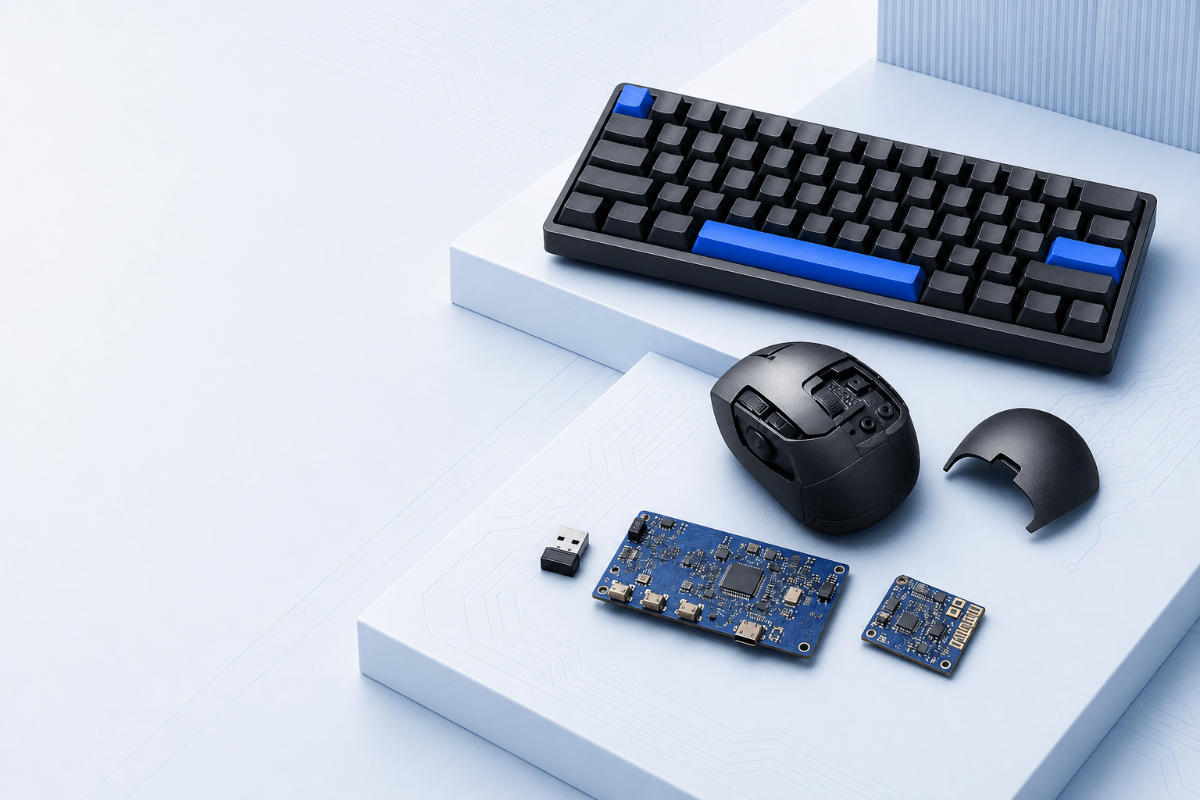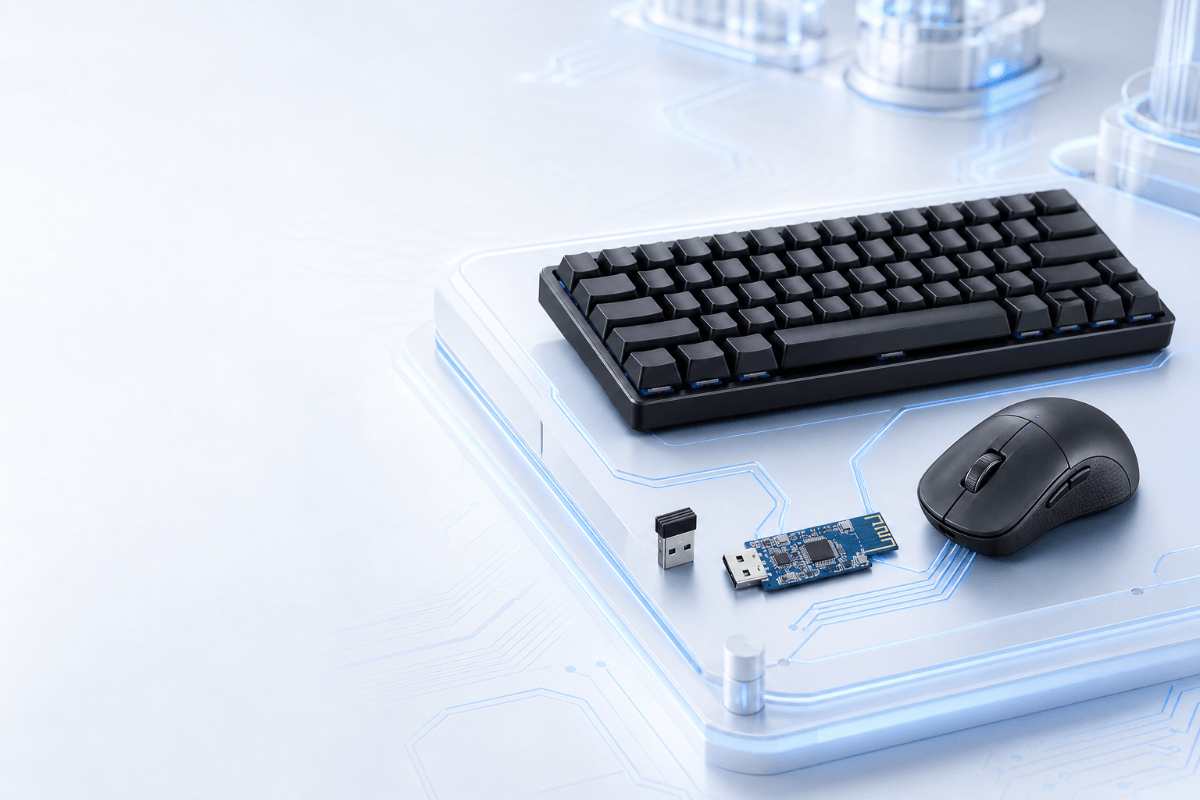


Keyboard Solution Capabilities
- 61 / 87 / 104-key mechanical keyboard layout integration
- N-key rollover, key mapping, and Win / Mac switching
- Wired, 2.4G, and three Bluetooth host switching
- RGB lighting, battery indication, and sleep management
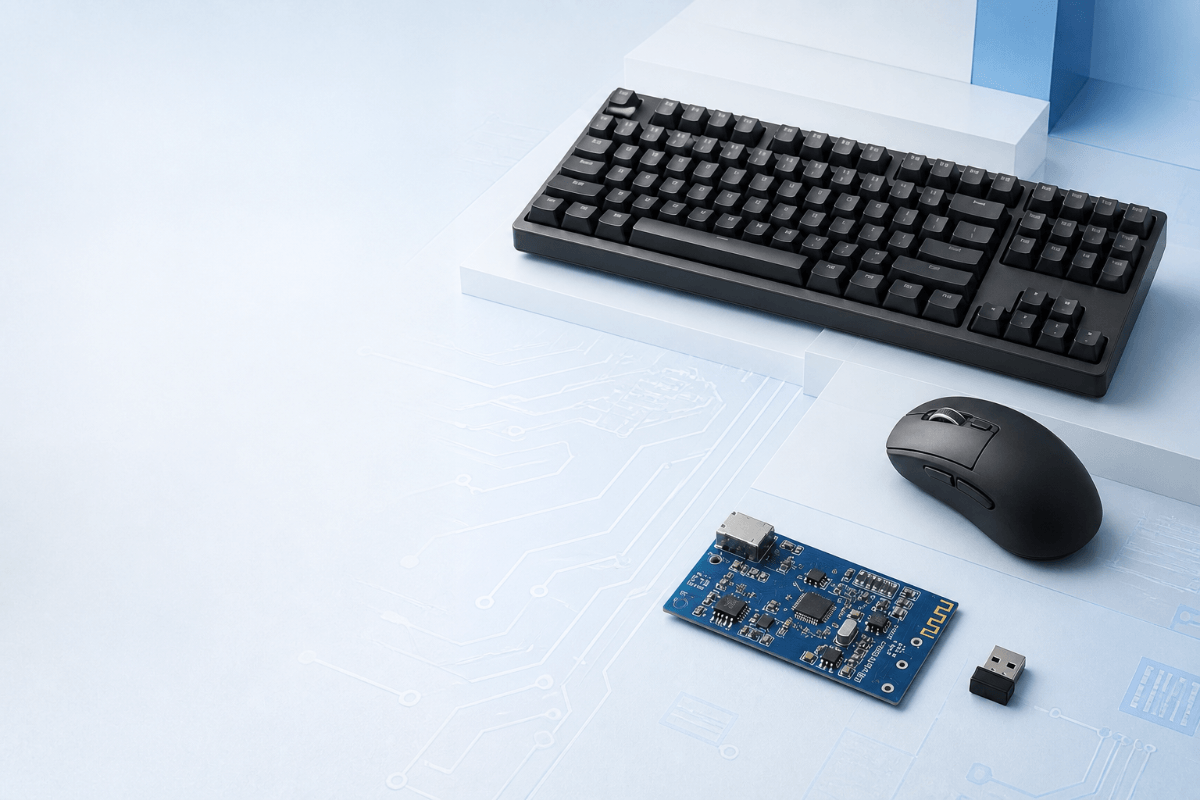
A mature tri-mode framework for shortening development and production introduction when requirements are clear
For tri-mode mice and mechanical keyboards targeting up to 1K polling with a clear feature scope. Enclosure, components, lighting, power, and drivers are integrated on a mature stack to control schedule, cost, and production risk.
Applications
Reuse validated connectivity, function, and power strategies while focusing engineering effort on device integration and production stability.
Keyboard Solution Capabilities
Mouse Solution Capabilities
Confirm first during project definition
Product form and enclosureSensor or keyboard layoutTarget costBattery and lightingDriver and delivery scheduleEngineering Capabilities
Tri-mode connectivity, hardware, firmware, receiver, driver, and production testing prioritize proven modules and controlled production risk.
Reuse validated wired, 2.4G, and multi-device Bluetooth switching, pairing, and reconnection logic.
Polling, DPI or keyboard matrix, controls, RGB, battery, and sleep functions aligned with the product definition.
Controller, sensor or keyboard matrix, antenna, power, charging, and PCBA design validation.
Joint debugging of the 2.4G receiver, pairing, reconnection, and recovery.
Branded software for controls, DPI, macros, lighting, profiles, and firmware updates.
Prototype validation, pilot runs, production testing, and issue closure.
Customization Scope
Four stages move clear requirements forward quickly while preserving necessary customization and reducing repeated development.
Designed around enclosure space, ports, battery, antenna, and target BOM.
Mouse sensors, encoders, and switches plus keyboard matrix and mechanical-switch selection.
Project-specific tri-mode switching, polling, DPI or keys, lighting, battery, and sleep strategy.
Integration with branded drivers, receiver tools, test fixtures, and production flows.
Selection Guidance
Choose FR2012A for clearly scoped dual-1K tri-mode programs that need fast production. Compare YJX-2012C when independent BOM planning and deeper software customization matter; evaluate nRF54L15 when dual-8K is the core target.
Prepare the product form, target cost, sensor or keyboard layout, battery, lighting, and delivery schedule.
Parameter Notes
Up to 1K wired and 2.4G polling and below 15mA mouse operating current depend on the complete-device configuration and test conditions. Keyboard power also varies with layout, matrix scanning, RGB lighting, and battery design; final values require prototype testing.